 Search for Double Beta Plus Decays |


|
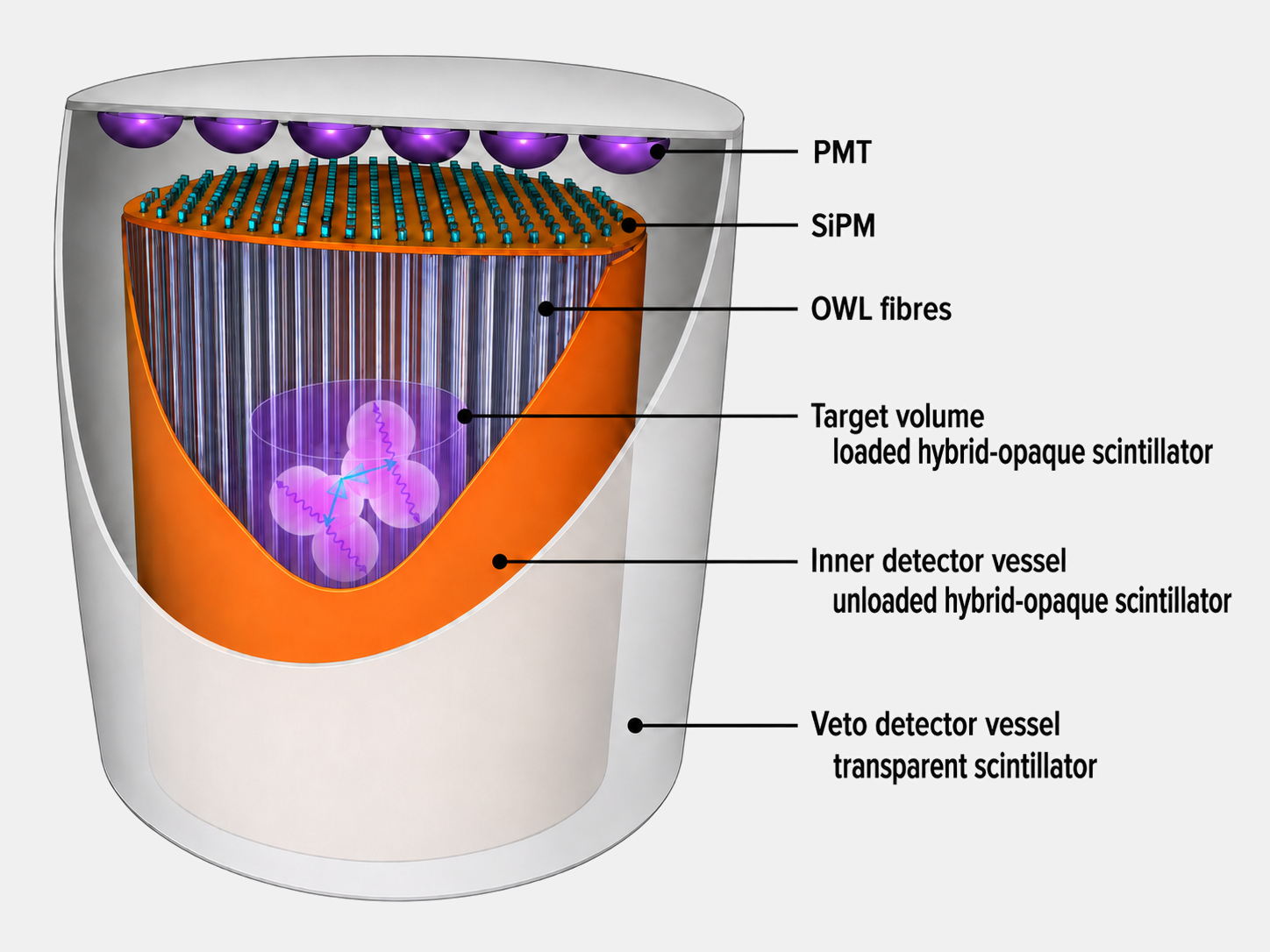
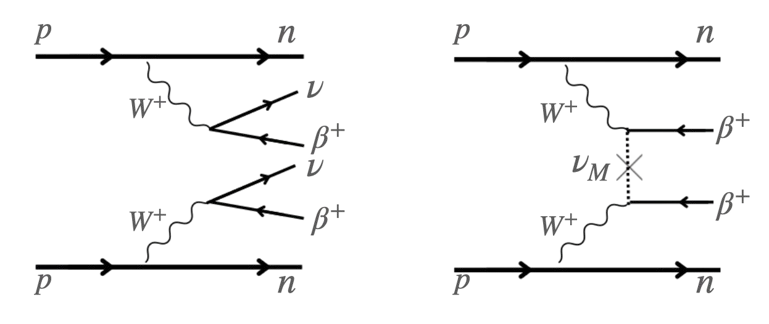
The NuDoubt++ ExperimentNuDoubt++ is a double beta decay experiment searching for rare positive double weak decays, including double positron decay (β+β+) and positron-emitting electron capture (β+EC). The experiment targets both Standard Model two-neutrino modes and BSM neutrinoless modes. Measuring these decays is challenging due to their low probability, difficult-to-detect signatures, and the scarcity of suitable candidate nuclei. To address these challenges, we have developed an innovative detector concept that combines hybrid slow and opaque scintillation detector technologies with novel light read-out techniques. This combination is particularly effective for identifying positrons. The NuDoubt++ Prototype
This setup is well-suited for initial measurements of two-neutrino double weak decays such as 2ν2β+ and 2νβ+EC, and for setting limits on the neutrinoless decays 0νβ+EC and 0ν2β+. The primary isotopes of interest are 78Kr, 124Xe, and 106Cd. Double Beta Plus Decays
Positron-emitting modes have distinctive experimental signatures. Each emitted positron eventually annihilates with an electron, producing two 511 keV gamma rays. This creates a combination of local energy deposition from the positron and additional gamma interactions nearby. These multi-site event topologies are especially well suited for a hybrid-opaque scintillator detector, which can use both timing information and spatial light patterns to identify signal-like events and reject backgrounds. 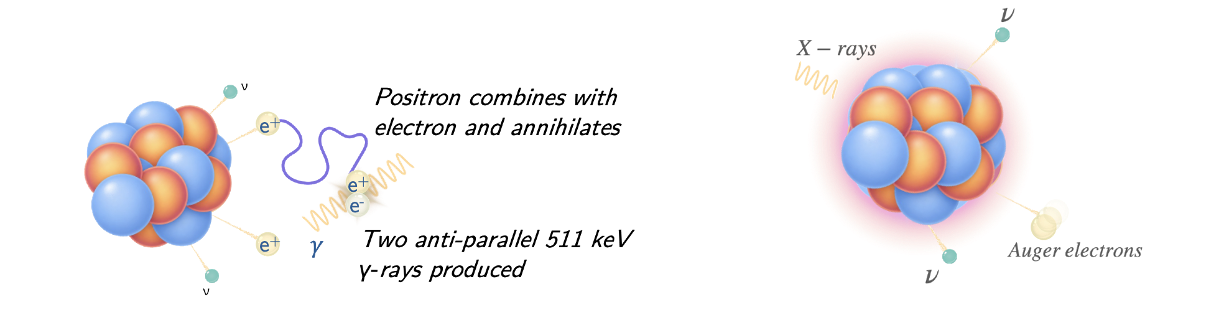
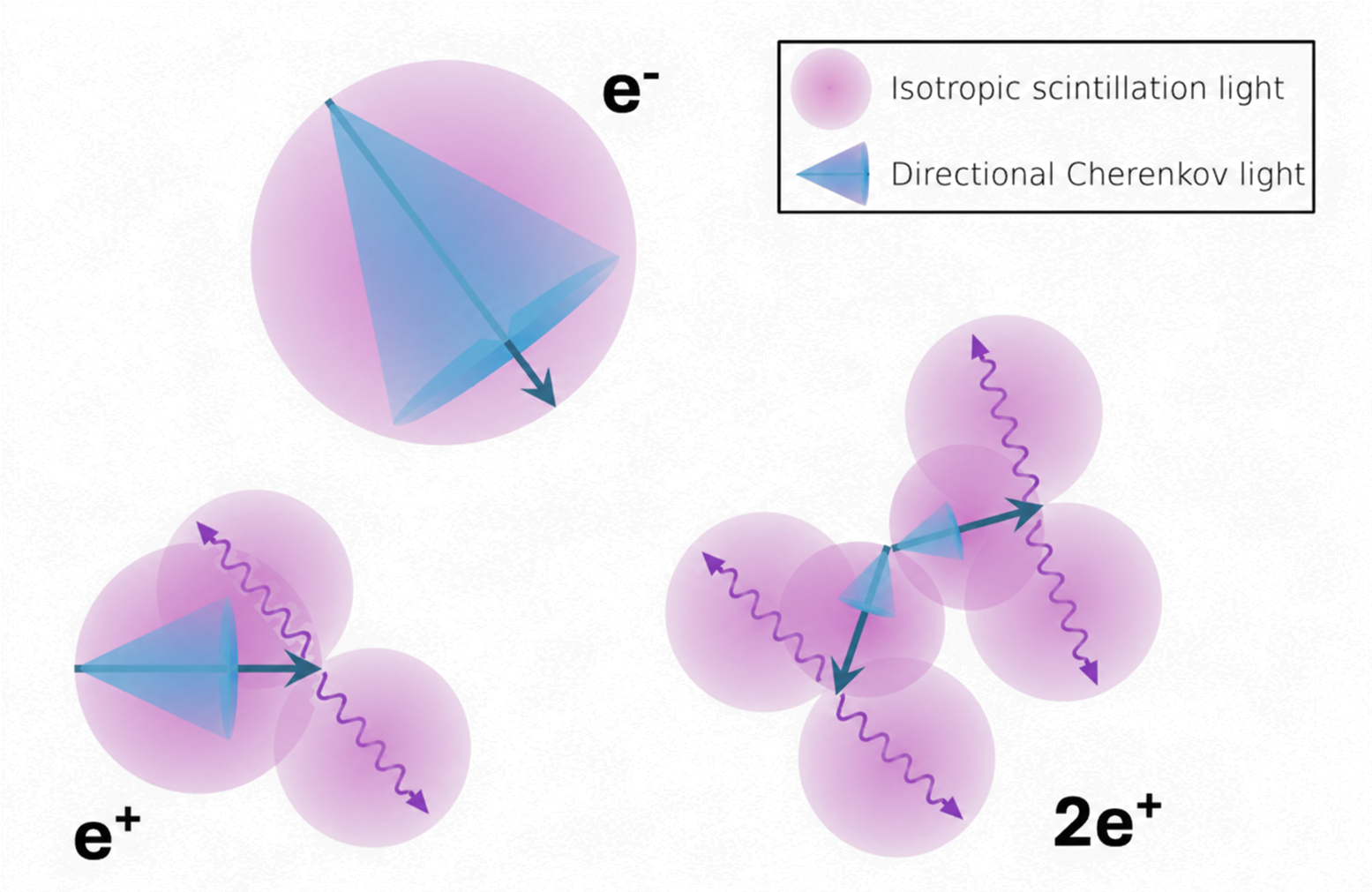
Studying β+β+, β+EC, and ECEC decays provides important tests of nuclear structure calculations and helps improve predictions for nuclear matrix elements. At the same time, searches for neutrinoless versions of these modes offer a complementary path toward discovering lepton-number violation and probing physics beyond the Standard Model. Hybrid-Opaque ScintillatorA key challenge in rare double-positron decay searches is the suppression of radioactive backgrounds. NuDoubt++ addresses this by using a hybrid-opaque scintillator, which combines two powerful event-identification techniques: the separation of Cherenkov and scintillation light, and the reconstruction of local energy-deposition patterns.
By combining the hybrid and opaque approaches, NuDoubt++ can exploit both timing and topology. The Cherenkov/scintillation ratio helps distinguish different particle types, while the opaque response provides spatial information about where the energy was deposited. This is especially useful for identifying the characteristic signatures of double-positron decay modes and rejecting backgrounds. Isotope Choice and Scintillator LoadingNuDoubt++ focuses on promising isotopes for positron-emitting double beta decay modes, such as 78Kr, 124Xe, and 106Cd. These isotopes provide high detectable energies, which helps separate potential signals from many natural radioactive backgrounds. The hybrid-opaque NoWaSH scintillator also makes high isotope loading more practical. In conventional transparent scintillators, large amounts of isotope can reduce transparency and degrade detector performance. In an opaque scintillator, light is collected locally, so the transparency requirements are much less strict. Noble gases such as krypton and xenon can be dissolved in the scintillator, with higher loading possible under increased pressure. For cadmium, solid compounds can be dispersed directly in the wax-based scintillator. This flexibility allows NuDoubt++ to explore different isotope candidates while maintaining good light collection and energy resolution. Optimised Wavelength-shifting Light-guides (OWL)For the NuDoubt++ experiment, we plan to utilize Optimised Wavelength-shifting fibres (OWL-fibres) to enhance light collection efficiency. These fibres are designed with the wavelength-shifters located on the outer surface, maximizing the probability of photon capture via total internal reflection. Polystyrene-based OWL-fibres can achieve a theoretical maximum trapping efficiency of up to 38%, capturing nearly four times more photons than conventional doped fibres with central emission points. Leveraging expertise from IceCube's Wavelength-shifting Optical Modules (WOMs), the OWL-fibres demonstrate superior light collection, making them ideal for high-performance opaque scintillation detectors. Initial tests indicate competitive performance even with reduced attenuation lengths. Stay tuned for more updates and detailed results from our ongoing research and development efforts in the NuDoubt++ experiment! | ||||||||||